
CashtoCode and Cryptocurrency
CashtoCode inverts the voucher model: instead of buying a code first, you start a payment online, receive a barcode, and pay cash at a participating shop. It is a neat solution to a real problem — and, like most voucher rails, it is concentrated in markets and merchant categories that have little to do with regulated US crypto.
- Generate a barcode online, pay cash in store, and the payment completes
- Strongest in online gaming; supports several currencies including USD
- Not accepted by any major Maryland-licensed crypto exchange
CEX.IO is legal to use in Maryland. It is registered with FinCEN as a Money Services Business and holds a Maryland money transmitter licence, NMLS ID 1804170.
Reviewed and updated August 2026
- Barcode
- The mechanism, rather than a pre-bought code
- USD, EUR, GBP
- Among the currencies supported
- Gaming
- The dominant merchant category
- Medium
- Scam exposure
No major Maryland-licensed crypto exchange accepts CashtoCode. Its merchant network is concentrated in online gaming rather than regulated financial services.
CashtoCode is a payment rail rather than a stored-value product, so there is nothing meaningful to buy with cryptocurrency.
How often this product appears in reported fraud, relative to others.
How the barcode model works
Most cash vouchers follow the same pattern: buy a code, then spend it. CashtoCode reverses the order, which solves a genuine problem with the traditional model.
The flow:
- Choose CashtoCode at a merchant's checkoutYou are already on the merchant's site with a specific amount to pay.
- Receive a barcode or referenceGenerated for that exact amount, valid for a limited window.
- Take it to a partner storeShow it at the counter and pay the amount in cash.
- The payment completesThe merchant is notified and your order goes through.
Why the inversion matters. Traditional vouchers force you to guess the denomination in advance, which leaves awkward remainders — $17.43 that is too small to use and too annoying to chase. CashtoCode is generated for the exact amount, so nothing is left over.
It also means there is no bearer code sitting in your pocket waiting to be stolen or scammed out of you, because the payment is tied to a specific transaction from the outset. That is a meaningful security improvement over a PIN-based voucher, and worth acknowledging.
CashtoCode supports multiple currencies including US dollars, and operates through retail partner networks in a number of countries.
Why it is not a crypto route in Maryland
No major exchange holding a Maryland money transmitter licence accepts CashtoCode, and the reasons are structural rather than arbitrary.
The merchant network is built for gaming. CashtoCode's partnerships are concentrated in online gaming and digital entertainment, where cash-paying customers without cards are a large and underserved segment. Cryptocurrency exchanges are a different merchant category with different compliance obligations on both sides of the transaction.
Anonymous cash payments are awkward for a licensed exchange. Under the Maryland Money Transmission Act and federal anti-money-laundering rules, an exchange must be able to tie incoming funds to a verified customer. A payment made in cash by an unidentified person at a shop counter makes that harder, not easier.
It is irreversible in both directions. Neither the customer nor the merchant can recall a completed cash payment. That is fine for a $20 game top-up and unattractive for a financial services firm that occasionally needs to reverse a transaction for compliance reasons.
The consequence for a Maryland reader is that anything advertising crypto purchases via CashtoCode is very likely a platform operating outside US state licensing. Check it on NMLS Consumer Access before funding anything — if Maryland does not appear with an active licence, the payment method is beside the point.
For a genuine cash-voucher route into crypto from Maryland, Flexepin is the one to look at, since CEX.IO publishes a Flexepin route and holds a Maryland licence.
Who this product is genuinely for
We are not dismissive of CashtoCode. It solves a real problem elegantly, just not this one.
The unbanked and underbanked. A meaningful share of US households lack a bank account or a card usable online, and that share is higher in parts of Maryland — Baltimore City in particular has one of the highest underbanked rates in the state. For those households, cash-to-online payment rails are the difference between participating in the digital economy and not.
People who want spending controls. Paying cash at a shop is a natural brake. You cannot spend more than you brought, and the trip itself introduces a pause. In gaming and gambling contexts that is arguably a feature rather than a limitation.
Privacy-conscious spending. Not anonymity — the merchant still knows who has an account — but it does keep a card number off a merchant's file and out of a future data breach.
Where it does not help is regulated financial services, where identity verification is mandatory and the whole point of the rail is undermined.
If the underlying problem is that you have no bank account and want to buy crypto, our cash guide addresses that directly — including the second-chance checking accounts several Maryland credit unions offer, which solve the problem rather than routing around it.
Safety notes and the Maryland verdict
The barcode is transaction-specific, which is a genuine advantage. Unlike a PIN-based voucher, a CashtoCode barcode is tied to one payment at one merchant. It cannot be redeemed for general value, which makes it considerably less useful to a scammer.
But the scam still exists in a modified form. A fraudster who has convinced a victim to create an account on a platform they control can direct them to generate a barcode and pay it in cash. The money reaches the fraudster's merchant account rather than a voucher balance. The end result is the same: cash gone, irreversibly.
The defence is unchanged: no government agency, court, police force, utility, bank or employer will ever direct you to a shop to pay cash against a barcode for a debt, a fine, a fee or a family emergency. If somebody is on the phone with you while you stand at a counter paying cash, hang up. Our Maryland scam guide covers the pattern in full.
Verdict for Maryland readers. CashtoCode is a well-designed payment rail for its intended market and is not a crypto on-ramp here. Anything claiming otherwise is a platform you should verify on NMLS Consumer Access before trusting with money — and the answer will usually be that no Maryland licence exists.
Compare with the other options in our voucher hub, and see the exchange comparison for platforms that do hold Maryland licences.
CashtoCode questions
Can I buy crypto with CashtoCode in Maryland?
Not through any major Maryland-licensed exchange. CashtoCode's merchant network is concentrated in online gaming rather than regulated financial services, and platforms advertising crypto purchases via CashtoCode are likely operating outside US state licensing. Check any platform on NMLS Consumer Access before funding.
How does CashtoCode work?
You select CashtoCode at a merchant's checkout, receive a barcode generated for that exact amount, take it to a participating store and pay in cash. The merchant is notified and the order completes. No bank account or card is required.
Is CashtoCode safer than a prepaid voucher?
In one specific way, yes. The barcode is tied to a single payment at a single merchant rather than being general bearer value, so a stolen barcode is far less useful to a thief than a stolen voucher PIN. The scam risk shifts rather than disappearing — a fraudster can still direct a victim to pay against a barcode on a platform the fraudster controls.
Can I get a refund on a CashtoCode payment?
Not through the payment rail. A completed cash payment cannot be recalled and there is no chargeback mechanism. Any refund would have to come from the merchant directly, under their own terms.
What should I use instead if I have no bank account?
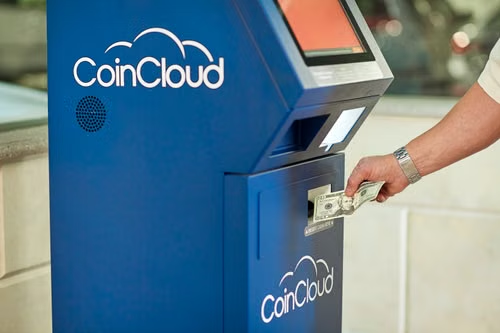
For crypto specifically, a registered kiosk or the Coinstar cash service will take banknotes, at 9–20% and around 16.5% respectively. The better answer is usually to open an account at a Maryland credit union — ask specifically about second-chance checking if you have been refused before — which then lets you buy on a licensed exchange for around 0.25%.
There is no shortcut that beats a licensed exchange
Every card and voucher workaround adds cost, adds counterparty risk, or both. A Maryland-licensed exchange funded by bank transfer costs about a quarter of a percent.
Crypto Maryland is an independent information site and does not provide financial advice.