
Bitcoin ATMs in Maryland: Locations, Fees and the 2026 Rules
Maryland now regulates crypto kiosks more tightly than most states — registration, daily caps, a fee ceiling and a refund process for fraud victims. Here is what that means at the machine, what it still does not cover, and how much you are really paying.
- Every operator must be state-registered and display an NMLS number since 1 January 2026
- Daily caps of $2,000 for new customers and $10,500 for established ones
- Fees capped at the greater of $5 or 15% — but the exchange rate is not capped
CEX.IO is legal to use in Maryland. It is registered with FinCEN as a Money Services Business and holds a Maryland money transmitter licence, NMLS ID 1804170.
Reviewed and updated August 2026
- $2,000
- First-day cap for a new customer
- $10,500
- Daily cap once established
- $5 / 15%
- Ceiling on the operator fee
- 90 days
- Window to file a fraud notice
01What a Maryland crypto kiosk actually is
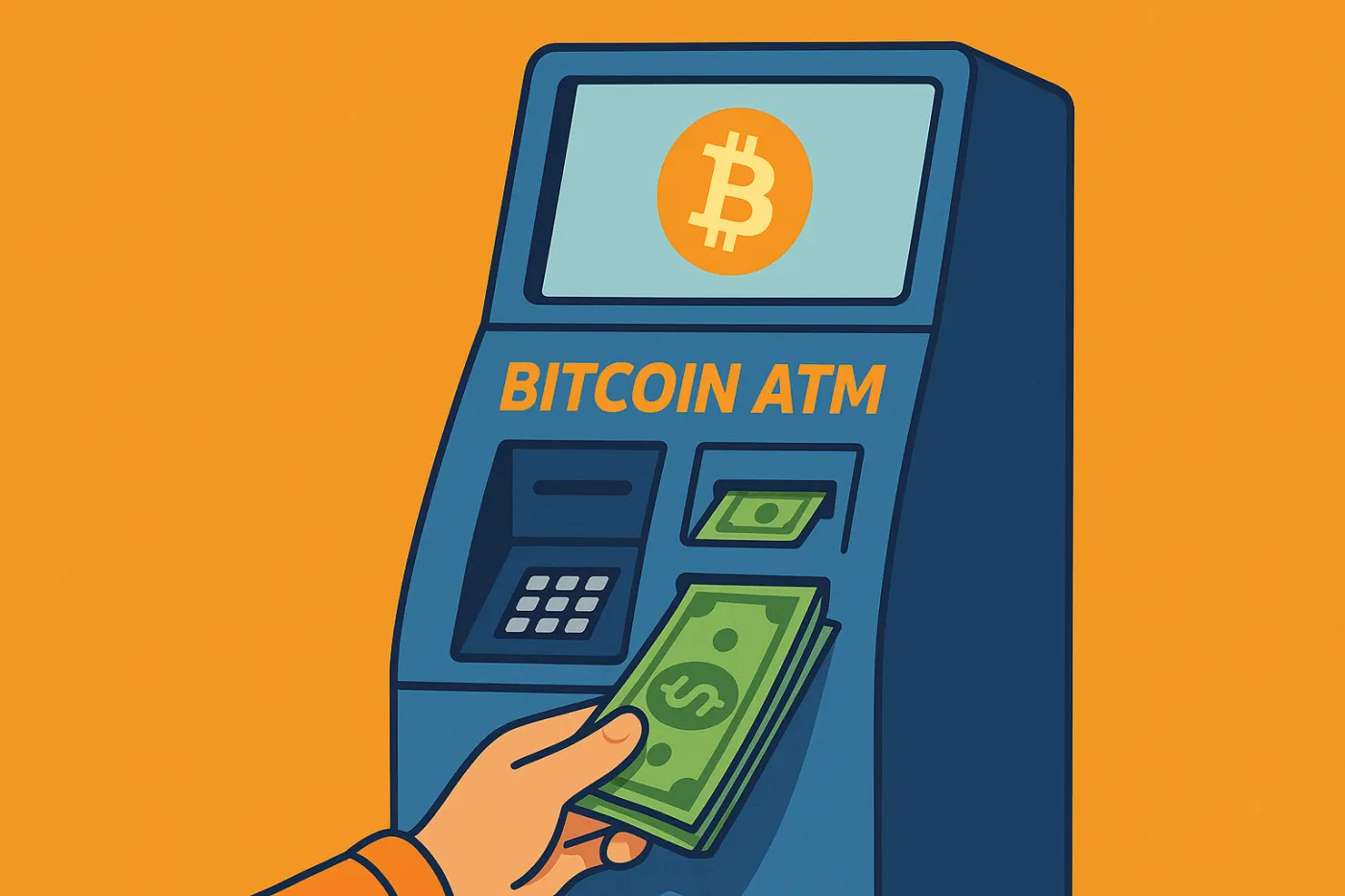
A virtual currency kiosk — the state's term, and a better one than "bitcoin ATM" — is a machine that takes physical banknotes and sends cryptocurrency to a wallet address you provide. It is not connected to your bank, it does not dispense cash in most Maryland locations, and the business whose shop it sits in usually has nothing to do with the company operating it beyond a rental agreement.
The transaction is simple. You scan a QR code representing your wallet address, or let the machine create a custodial wallet for you. You verify your identity — a phone number, a photo of your ID, sometimes a selfie. You feed in cash. The machine quotes a price, you confirm, and the coins are broadcast to the blockchain within minutes.
What you are paying for is speed and the absence of a bank account. What you are paying is somewhere between nine and twenty percent, split between a fee the machine shows you and an exchange rate it does not draw attention to.
The operators you will encounter most often in Maryland are CoinFlip, Bitcoin Depot, Athena Bitcoin and the Coinme network riding on Coinstar hardware inside supermarkets. All four are national businesses of a size that made Maryland's 2026 registration requirement worth complying with. A significant number of smaller independent operators did not comply and exited the state.
One Maryland-specific quirk worth knowing before you plan anything: a large share of the machines here are buy-only. They take cash and send crypto but will not do the reverse. If you think you might want to sell, an exchange with an ACH withdrawal to your bank is a far more reliable route.
02The 2026 rules, in plain English
Maryland now has one of the more prescriptive crypto kiosk regimes in the country, and it is genuinely worth understanding because most of it exists for your benefit.
The statute is Senate Bill 305 of the 2025 session, sponsored by Senator Pamela Beidle, signed by Governor Wes Moore on 22 April 2025 and enacted as Chapter 117. It took effect on 1 July 2025, and registration through NMLS became mandatory on 1 January 2026. The Commissioner of Financial Regulation then issued implementing regulations at COMAR 09.03.16.
| What the law requires | What it means at the machine |
|---|---|
| Operator registration | Every operator must register with the Commissioner through NMLS — $2,000 per operator plus $200 per kiosk — and display its NMLS identifier. No number on screen means no legal registration. |
| Daily transaction caps | $2,000 per day for a new customer; up to $10,500 per day for an established one. Per person, per day. |
| Fee cap | The operator may charge no more than the greater of $5 or 15% of the transaction amount. |
| On-screen disclosures | Fraud warnings and disclosures must stay visible for a minimum duration — at least four seconds for a short notice, proportionally longer for longer ones. |
| Receipt contents | Operator name and contact details, NMLS identifier, date, dollar amount, exchange rate, destination wallet address, transaction hash, and all fees or taxes. |
| Fraud refunds | You may file a Notice of Fraud within 90 days. The operator must investigate and resolve within 30 calendar days, may not require a police report, and may not deny the claim because you were negligent or ignored warnings. |
| Compliance controls | A designated chief compliance officer, blockchain analytics screening for high-risk and sanctioned wallets, risk-based post-transaction monitoring, and annual reporting on volumes, fraud notices, refunds and denials. |
| Penalties | Civil penalties up to $1,000 for each knowing and wilful violation. |
§ The gap the law leaves open
Maryland caps the fee. It does not cap the exchange rate the machine uses. A kiosk pricing bitcoin four percent above the market while charging a lawful 15% fee is taking nineteen percent of your money. The receipt is required to show the rate — read it, and compare against a live price on your phone before confirming.
03What Maryland kiosks really charge
Published operator schedules and independent comparisons put the large national networks in a broadly similar band. CoinFlip has publicly cited figures in the region of 8.99% on purchases and 4.99% on sales; Bitcoin Depot's buy-side pricing has been reported around 10%; and the Coinme service on Coinstar hardware has quoted a cash exchange fee in the region of 16.5% depending on location. Independent single-machine operators frequently sit higher, and industry-wide averages across all US machines have been reported in the low twenties once the spread is included.
Here is what that looks like in dollars, on the transaction sizes people actually make:
| Cash in | Fee at cap | Rate markup | You receive | All-in |
|---|---|---|---|---|
| $50 | $7.50 | ~$1.30 | ~$41.20 | ~17.6% |
| $100 | $15.00 | ~$2.55 | ~$82.45 | ~17.6% |
| $300 | $45.00 | ~$7.65 | ~$247.35 | ~17.6% |
| $500 | $75.00 | ~$12.75 | ~$412.25 | ~17.6% |
| $2,000 | $300.00 | ~$51.00 | ~$1,649 | ~17.6% |
Note the small-transaction problem the cap creates. Maryland allows the greater of $5 or 15%, so on a $25 purchase the $5 floor applies — a twenty percent charge, entirely lawful. The cap protects large transactions well and small ones barely at all, which matters because small transactions are what most first-time users make.
Compare a licensed exchange on the same purchases: a 0.25% spot fee on $500 is $1.25. That is not a marginal difference, it is a factor of roughly seventy.
04Where the machines are in Maryland
Kiosk placement follows the cash economy rather than population or wealth. Machines cluster where there is dense convenience retail serving customers who transact in banknotes, and they are almost absent where everyone has a bank account.
Dense coverage:
- Baltimore City — the densest network in the state, along Broadway through Fells Point, Eastern Avenue through Highlandtown, and the York Road corridor
- Dundalk, Essex and Middle River — Merritt Boulevard, North Point Boulevard, Eastern Boulevard
- Laurel and the Route 1 corridor through College Park and Hyattsville
- Glen Burnie and Ritchie Highway north to Brooklyn Park
- Silver Spring and Wheaton — Georgia Avenue, Piney Branch Road, University Boulevard
Moderate coverage: Rockville Pike, Gaithersburg, Germantown, Towson, Frederick's Golden Mile, Waldorf on US 301, and Bowie on Route 197.
Sparse or absent: Bethesda, Chevy Chase and Potomac; most of Howard County outside the Route 1 belt; Carroll, Washington and Wicomico Counties; northern Baltimore County; and effectively all of the Eastern Shore outside Salisbury.
We deliberately do not publish a fixed address list. Placements change constantly as host businesses open, close and change hands, and a stale list sends people on wasted drives. Use the operator's own live location finder — CoinFlip, Bitcoin Depot and Coinme all publish one — and check the same day you intend to travel, particularly in western Maryland and on the Shore where a single removal is a large share of local supply.
05How to use a Maryland kiosk without being taken advantage of
If a machine is genuinely your best option — you are paid in cash, you cannot use a bank, and you need this today — here is how to do it with the least damage.
- Check for an NMLS number before anything elseIt must be displayed on screen or on the machine. Since 1 January 2026 this is a legal requirement. No number means the operator is not registered with Maryland and you have no realistic recourse.
- Compare the quoted rate against a live priceOpen any price app on your phone. If the machine's price is more than two or three percent above the market, that gap is an undisclosed cost on top of the stated fee.
- Prefer a large national operatorCoinFlip, Bitcoin Depot, Athena and Coinme machines generally price better than unbranded independents and have real support lines you can reach.
- Verify your own wallet addressCheck the first and last several characters against your wallet app. Never scan a QR code that somebody else provided, and never let anyone "help" you with the screen.
- Bring only what you intend to spendYou will be handling cash in public. Go in daylight, use a well-lit forecourt machine rather than a small unlit storefront, and do not linger.
- Take the receipt and photograph itMaryland requires it to show the operator, NMLS ID, amount, exchange rate, destination address and transaction hash. You need those for any complaint and again at tax time.
- Know your limit before you go$2,000 in a day if you are new to that operator; up to $10,500 once established.
And one absolute rule that overrides everything above: if anyone is on the phone with you while you stand at the machine, stop and leave. That is not a precaution, it is the single most reliable indicator of fraud in this entire market.
06The alternative, and why we keep pushing it
We are not anti-kiosk. They are a legitimate, now well-regulated service that solves a genuine problem for people the banking system has served badly. What we are against is people paying kiosk prices when they do not have to.
The comparison, on $300 a month for a year:
| Route | Annual cost | Requires |
|---|---|---|
| Licensed exchange, ACH, advanced interface | ~$9 | A bank or credit union account |
| Licensed exchange, debit card | ~$126 | A debit card |
| Large-network kiosk at 12% | ~$432 | Cash and a machine nearby |
| Kiosk at Maryland's cap plus markup | ~$634 | Cash and a machine nearby |
The bridge between the top row and the bottom is a bank account, not any crypto knowledge. Several Maryland credit unions offer second-chance checking accounts designed for people with a negative ChexSystems history — they typically carry a small monthly fee and graduate to a standard account after a period of good conduct. Bring a Maryland driver's licence or state ID and proof of address. It is a one-hour appointment.
Once you have an account: check your chosen platform's Maryland licence on NMLS Consumer Access, link the account by ACH, and buy on the advanced trading interface rather than the simple buy button. Our top 10 exchanges page covers which platforms are actually licensed here.
One caution on cash deposits. Routine federal reporting on large cash transactions is automatic and requires nothing from you. Deliberately splitting deposits to stay below a reporting threshold is structuring, a federal offence in its own right independent of where the money came from.
07Your rights if something goes wrong
Maryland's kiosk law exists primarily because of one crime pattern, and it gives victims a defined remedy that did not exist before.
The Notice of Fraud process. Under COMAR 09.03.16 you may submit a Notice of Fraud to the operator within 90 days of the transaction. The operator must investigate and resolve the claim within 30 calendar days. It may not require you to file a police report as a precondition, and it may not deny a fee refund on the grounds that you were negligent or ignored the machine's on-screen warnings. Operators must report annually to the Commissioner how many notices they received and how many they denied — which is the provision with real teeth, because it creates a paper trail a regulator can act on.
What that recovers. The fees. The cryptocurrency itself is almost always gone — blockchain transactions are irreversible by design and there is no chargeback mechanism. Be clear-eyed about that when weighing whether to use a machine at all.
Who else to tell:
- Maryland Office of Financial Regulation — licensing, fees, receipts, refusal to refund, unregistered machines
- Maryland Attorney General, Consumer Protection Division — scams and deceptive practices
- Your county police or sheriff — for the local criminal report
- FBI Internet Crime Complaint Center (IC3) — the federal record that feeds national pattern analysis
Bring the receipt. The transaction hash printed on it is the single most useful piece of information an investigator can have, because it identifies the exact on-chain transfer.
Our Maryland scam guide sets out each local variant of the impersonation script and what to do in the first hour after a loss.
Maryland bitcoin ATM questions
How many bitcoin ATMs are there in Maryland?
The count moves constantly and no static figure stays accurate for long. Baltimore City has the densest concentration in the state, followed by the Route 1 corridor through Prince George's County and the Ritchie Highway corridor in Anne Arundel County. Coverage is thin in western Maryland and on the Eastern Shore, and thinned further after the January 2026 registration deadline. Use the operator's own live map rather than any published list.
Are bitcoin ATMs legal in Maryland?
Yes, but they are regulated. Since 1 January 2026 every virtual currency kiosk operator must be registered with the Maryland Commissioner of Financial Regulation through NMLS and display its NMLS identifier on the machine. Registration costs $2,000 per operator plus $200 per kiosk, and operators must maintain a chief compliance officer, screen wallets using blockchain analytics, and report annually to the state.
What are the daily limits on Maryland crypto kiosks?
$2,000 per person per day for a new customer and up to $10,500 per person per day for an established customer. These caps are set by state statute, not by individual operators.
How much do bitcoin ATMs charge in Maryland?
Maryland caps the operator fee at the greater of $5 or 15% of the transaction. The exchange rate the machine uses is not capped, so all-in costs typically land between 9% and 20%. Large national operators sit toward the lower end and unbranded independents toward the higher end.
Can I sell bitcoin at a Maryland ATM?
Often not. A large share of Maryland machines are buy-only — they accept cash and send crypto but will not do the reverse. If you need to cash out, selling on a licensed exchange and withdrawing by ACH to your bank is cheaper and far more reliable than hunting for a two-way machine.
Do Maryland bitcoin ATMs require ID?
Yes. Federal anti-money-laundering rules require identity collection, and Maryland's 2025 kiosk law requires registered operators to collect customer information. Expect at minimum a phone number and a photo of your ID, often a selfie as well. Any machine advertising anonymous purchases in Maryland is not complying with state law.
What should I do if I was scammed at a Maryland bitcoin ATM?
File a Notice of Fraud with the operator within 90 days. Maryland regulation requires them to investigate within 30 calendar days, bars them from requiring a police report as a precondition, and bars them from denying a fee refund because you ignored on-screen warnings. Also report to the Maryland Office of Financial Regulation, the Attorney General's Consumer Protection Division, your county police and the FBI's IC3. Keep the receipt — it carries the transaction hash.
Which is cheaper, a bitcoin ATM or an exchange?
An exchange, by a very wide margin. A licensed exchange funded by ACH charges around 0.25% against 9–20% all in at a kiosk. On $1,000 that is roughly $2.50 versus $90–200. The only situation where a kiosk makes sense is physical cash you cannot deposit at a bank.
Related Maryland guides
Stop paying kiosk prices
One afternoon setting up a licensed exchange account with an ACH bank link permanently converts a double-digit fee into a fraction of a percent.
Crypto Maryland is an independent information site and does not provide financial advice.