
Where and How to Buy Crypto in Hagerstown, Maryland
Hagerstown sits where I-70 meets I-81 — the freight crossroads of the Mid-Atlantic — and its crypto landscape looks nothing like the Baltimore–Washington corridor. Fewer machines, longer drives, and a much stronger case for doing everything online.
- Western Maryland has noticeably thinner kiosk coverage than the I-95 corridor
- Local supply concentrates on Dual Highway and the Route 40 / Halfway retail strips
- For most Washington County residents, an exchange is not just cheaper — it is more practical
CEX.IO is legal to use in Maryland. It is registered with FinCEN as a Money Services Business and holds a Maryland money transmitter licence, NMLS ID 1804170.
Reviewed and updated August 2026
- ~157k
- Washington County residents
- I-70 × I-81
- The freight crossroads Hagerstown was built on
- 1762
- Year Hagerstown was founded
- 0.25%
- Spot fee at a licensed exchange
Why western Maryland has fewer machines
Crypto kiosks are a retail business with a simple economic model: a machine needs enough transaction volume in a small radius to cover the rent, the cash logistics, the compliance overhead and the capital cost of the hardware. That maths works in a dense corridor with a large cash economy. It works poorly in a county of 157,000 people spread across 460 square miles.
Add Maryland's 2025 regulatory regime and the picture sharpens further. Registration through NMLS costs $2,000 for the operator plus $200 per kiosk. Operators must designate a chief compliance officer, screen destination wallets against blockchain analytics for high-risk and sanctioned addresses, monitor transactions on a risk basis, and file annual reports covering transaction volumes, fraud notices received, refunds granted and denials issued. Those are fixed costs. A national operator with hundreds of machines absorbs them easily; a local operator with five does not.
The consequence for you is practical rather than philosophical. Third-party kiosk maps are less accurate here than in Baltimore, because a single removal is a much larger share of the total. Before driving anywhere, check the operator's own location finder — CoinFlip, Bitcoin Depot and Coinme all maintain them — and ideally check the same day.
The upside: what remains is compliant. A machine still operating in Hagerstown in 2026 belongs to an operator that went through registration, which means a real company, a real complaint route and a real fraud-refund process.
The online route, which is the right one here
In a place with thin machine coverage, the online route stops being merely cheaper and starts being obviously more sensible.
The setup is the same everywhere: choose a platform that holds a Maryland money transmitter licence, verify your identity with a Maryland driver's licence, link a checking account at a Hagerstown bank or a Washington County credit union, and buy on the advanced interface where the fee is published rather than baked into a spread.
What changes in western Maryland is the comparison. In Baltimore the kiosk is ten minutes away and costs twelve percent. In Hagerstown it may be twenty-five minutes away, may not be operating, and still costs twelve percent. Meanwhile the exchange is on your phone, costs a quarter of a percent, and works at eleven at night.
- Verify the licenceSearch the platform on NMLS Consumer Access. Confirm Maryland appears and the status is active. CEX.IO, for instance, is listed under NMLS ID 1804170 and is registered with FinCEN as a Money Services Business.
- Link a bank, not a cardACH is free on most platforms; card purchases cost three to four percent.
- Set up a recurring buy if you buy regularlyIt removes the decision and removes the trip.
- Use an authenticator app for two-factorNot SMS. SIM swapping defeats text-message codes.
- Move long-term holdings to a hardware walletRural Maryland has excellent conditions for the one thing self-custody demands: a genuinely secure physical place to keep a paper backup.
One connectivity note that matters outside the city: parts of Washington County have patchy mobile coverage. Do not begin a transaction — especially a self-custody transfer — somewhere you might lose signal partway through.
The freight economy and cash
Hagerstown exists because of transport. The city grew as a rail and road junction and today sits at the crossing of I-70 and I-81, surrounded by distribution centres and trucking operations. That economy has real crypto relevance.
Owner-operators and small trucking businesses often deal in irregular, lumpy income and a more cash-adjacent set of financial habits than a salaried worker. Some are interested in crypto as a hedge against a bad quarter; some as a way to move money quickly; some because a customer offered to pay in it.
Three straight answers for that audience. First, if a customer offers to pay in crypto, use a processor that settles in dollars the same day. Holding it turns a haulage business into a speculative one and creates a taxable event on every later conversion. Second, business crypto activity has bookkeeping consequences that go well beyond a personal purchase — talk to an accountant before, not after. Third, be extremely wary of anyone offering to convert crypto to cash for you outside a licensed venue. In Maryland, running that as a business without a licence is unlicensed money transmission, and being on either side of it is a bad position.
For personal buying, the same advice applies as to anyone: a licensed exchange, funded by bank transfer. Truck-stop kiosks along the interstates are the most expensive machines you will find anywhere in the state, and their captive audience is exactly why.
Maryland rules, applied to Washington County
There is no Hagerstown or Washington County crypto ordinance. State law governs, and it is worth knowing the three pieces that touch you.
Money transmission. Title 12 of the Financial Institutions Article requires a Maryland licence for anyone in the business of transmitting money, which includes crypto exchanges serving Maryland customers. The Office of Financial Regulation supervises this and takes consumer complaints.
Virtual currency kiosks. Chapter 117 of 2025 (Senate Bill 305), effective 1 July 2025 with registration mandatory from 1 January 2026, plus regulations at COMAR 09.03.16. Daily caps of $2,000 for new customers and $10,500 for established ones. Operator fees capped at the greater of $5 or 15%. Mandatory on-screen disclosures, detailed receipts including the transaction hash, signage directing complaints to the Commissioner, and a Notice of Fraud process with a 90-day filing window and 30-day resolution deadline.
Income tax. Crypto is property. Gains are ordinary income at Maryland rates up to 5.75%, with no long-term preference, plus Washington County's piggyback income tax. From tax year 2025, a 2% state surcharge applies to capital gains for filers with federal AGI above $350,000.
And the restriction that is not a statute: the 2023 Maryland Securities Commissioner order that ended Coinbase's staking service for state residents. Kraken and Crypto.com exclude Maryland too. Legislation introduced in the 2026 session would clarify staking's status; see our staking page.
Practical notes for rural Washington County
A few things that matter more here than in the suburbs.
Storage is genuinely easier. Self-custody's main practical demand is a secure physical location for a paper or metal backup that is not your house's obvious desk drawer, and not somewhere a flood or fire takes out along with everything else. Rural properties often have better options than a city apartment. Use them properly: two copies, separate buildings, neither one photographed.
Connectivity matters. Verify your wallet address and complete transactions where you have reliable signal. A transfer interrupted mid-broadcast is usually fine, but a self-custody setup interrupted mid-backup is not.
Local banking is a real advantage. Community banks and credit unions in Washington County are more likely to actually talk to you about an unusual transaction than a national bank's call centre. If you plan a large purchase or sale, a conversation in advance prevents the frozen-account problem that catches people out.
Neighbouring states are not a shortcut. Hagerstown is close to both Pennsylvania and West Virginia, and people occasionally ask whether crossing a line changes anything. It does not change your obligations: you are taxed as a Maryland resident, and the platform serving you needs a Maryland licence. Using a machine in Pennsylvania is legal, but it does not move your tax residence or exempt you from anything.
For a wider picture of the region, see our Washington County guide and the Frederick city guide, which covers the nearest larger market.
Where crypto kiosks cluster in Hagerstown
Hagerstown's retail runs east along Dual Highway toward the interstate and south toward Halfway and the Valley Mall area. That is where the machines are, when they are there at all. Downtown around Public Square and the arts district has essentially none, and coverage drops away sharply once you leave the city.
| Area | Where exactly | Venue type | What to expect |
|---|---|---|---|
| Dual Highway (US 40 East) | Between Eastern Boulevard and I-70 | Gas stations, convenience retail | The most reliable local supply; easy parking and long hours. |
| Halfway / Valley Mall | Massey Boulevard, Halfway Boulevard | Strip-mall retail, Coinstar | Coinstar cash-to-voucher inside the grocery anchors; occasional dedicated kiosks. |
| Virginia Avenue | US 11 south toward Williamsport | Convenience stores | Intermittent supply. Call ahead or check the live map. |
| Pennsylvania Avenue | US 11 north toward Maugansville | Gas station convenience | Serves the northern residential fringe; thin coverage. |
| Downtown Hagerstown | Public Square, Potomac Street | Very limited | Effectively no kiosk supply. Plan on an exchange. |
| Interstate service areas | I-81 and I-70 exits | Truck-stop convenience | Serves the freight economy; machines here run long hours but carry high markups. |
Top exchanges serving Hagerstown residents
Every platform below accepts customers with a Maryland address. The staking column is the one that catches people out — it is restricted statewide, not just in Hagerstown.
| # | Exchange | Best for | Trading fee | Staking in MD | Score | Visit |
|---|---|---|---|---|---|---|
| 1 | CEX.IO | Overall for Maryland residents | From 0.25% | Partly limited | 4.8 | Open account |
| 2 | Coinbase | For absolute beginners | 0.60% / 1.20% base | Feature blocked | 4.5 | Visit site |
| 3 | Kraken | Security track record | 0.25% / 0.40% | Feature blocked | 4.5 | Visit site |
| 4 | Gemini | For compliance-minded savers | 0.20% / 0.40% | Partly limited | 4.2 | Visit site |
| 5 | Crypto.com | Crypto debit card | 0.25% / 0.50% | Feature blocked | 4.0 | Visit site |
Hagerstown crypto questions, answered
Are there bitcoin ATMs in Hagerstown?
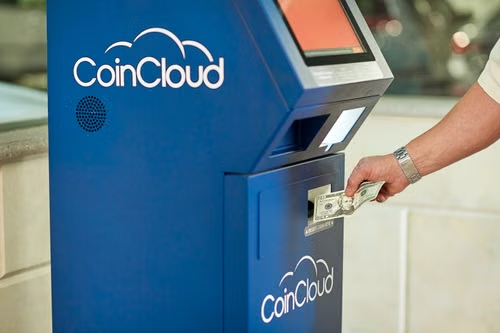
Some, but coverage is thinner than in central Maryland and less stable. The most reliable supply is along Dual Highway (US 40 East) and around Halfway and the Valley Mall area, plus Coinstar machines in supermarket anchors. Downtown Hagerstown has essentially none. Always check the operator's own live map the same day you plan to travel.
Why are there fewer crypto machines in western Maryland?
Simple economics plus the 2026 registration regime. A kiosk needs dense local transaction volume to justify rent, cash logistics and compliance costs, and Washington County's population is spread thinly. Maryland's registration requirement — $2,000 per operator plus $200 per machine, a chief compliance officer, blockchain analytics screening and annual reporting — added fixed costs that small local operators could not spread across enough machines.
What is the best way to buy crypto in Washington County?
A licensed exchange funded by ACH from a local bank or credit union. It costs roughly 0.25% against 9–20% at a kiosk, works at any hour, and does not require a drive that may end at a machine that is no longer there.
Can I use a bitcoin ATM in Pennsylvania or West Virginia instead?
Legally, yes — but it changes nothing about your obligations. You remain a Maryland resident for tax purposes, your gains are taxed as Maryland ordinary income with the Washington County piggyback rate, and any platform serving you still needs a Maryland licence. Crossing a state line to use a machine is not a workaround for anything.
Does Washington County tax cryptocurrency?
Not with a separate crypto tax. Maryland state income tax applies to your gains as ordinary income, with Washington County's piggyback income tax on top, plus a 2% state surcharge on capital gains for filers above $350,000 federal AGI from tax year 2025.
Ready to buy crypto in Hagerstown?
Open an account with a platform whose Maryland licence you can verify yourself on NMLS Consumer Access, then fund it by bank transfer rather than card.
Crypto Maryland is an independent guide. We do not provide financial advice.